Administrative Culture in Developing and Transitional Countries by Ishtiaq Jamil & Steinar Askvik & Farhad Hossain
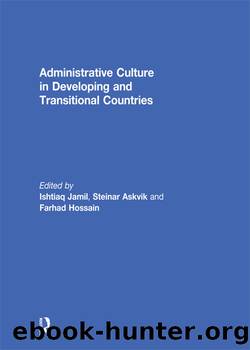
Author:Ishtiaq Jamil & Steinar Askvik & Farhad Hossain [Jamil, Ishtiaq & Askvik, Steinar & Hossain, Farhad]
Language: eng
Format: epub
Tags: Political Science, General
ISBN: 9781138816398
Google: z0YDoQEACAAJ
Goodreads: 22264241
Publisher: Routledge
Published: 2014-11-03T06:12:45+00:00
PERFORMANCE APPRAISAL AND ADMINISTRATIVE CULTURE: A CONCEPTUAL OVERVIEW
The co-option and popularity of culture as a concept in public administration and management studies has existed for several decades, but remains a contentious subject. While tracing its origins to social anthropology, the use of culture in organizational studies has attracted widely divergent views and interpretations that are broadly attributed to theoretical hollowness and the multi-dimensionality of the construct (Ogbonna, 1992; Harris & Ogbonna, 2002). Existing literature has fully underscored prevailing conceptual, theoretical, and definitional debates as well as perspectives through which culture is studied and understood in organizational settings (see Legge, 1994; Driscoll & Morris, 2001; Ogbonna & Harris, 2002). This would therefore not be repeated here.
Nonetheless, recurrent themes in most of the discussions of administrative culture present culture as a collection of intangible assumptions, manifested in shared values, behaviors, beliefs, artifacts, and sometimes in myths (Ogbonna, 1992; Newman, 1994; Harris & Ogbonna, 2002). If administrative culture is understood as a collection of common values, attitudes, codes, and behaviors shared by individuals, teams, and groups in organizational settings, then construing performance appraisal as a normative process would imply that some level of agreement or acceptance is reached by the parties involved. However, in practice, this might not be the case as the introduction of performance appraisal could attract negative reactions (Cleveland & Murphy, 1992; Poon, 2004). There is evidence that employee performance could be severely undermined when the appraisal instrument fails to obtain full legitimacy of the stakeholders involved (Greenberg & Tyler, 1987).
Generally, the purpose for, and the response to the introduction of appraisal is seen as the starting point for its admission into an institutionâs culture. Daley (1993) contends that employee appraisal could be deployed to satisfy âdevelopmentalâ and âjudgmentalâ purposes that are linked to organizational goals and standards. According to this categorization, developmental purposes are those aimed at building staff capacity and expertise through training, while judgmental purpose refers to actions such as promotions, performance-based pay increases, demotions, reinstatement, merit pay, or reassignments (Daley, 1993). While this distinction may be instrumental for an organizationâs performance management system, it does not illuminate the procedural features and integrity associated with the categories.
Contextualizing administrative culture as shared traits of public servants and bureaucrats within the American political system, Henderson (2004) examined the evolution of administrative culture from incipient patrician notions that made public administration a preserve for âgentlemen,â through a transition period of widespread spoils that motivated public office holders to perform, to present merit-based administrative cultures. This path-dependent differentiation demonstrates how variations in administrative needs and contexts created sub-cultures that started as traditional, became inwardly self-protective, and now entrepreneurial in nature. The weakness of the above shifts in administrative culture is the failure to indicate how performance is measured under each phase. While the drive to âreinvent governmentâ (Hood, 1991) by adopting New Public Management strategies encourages public institutions to treat citizens as âbusiness customers,â the impetus for entrenching performance appraisal in the civil service should be derived from the commitment to transform operational performance that is related, by design, to strategic objectives.
Download
This site does not store any files on its server. We only index and link to content provided by other sites. Please contact the content providers to delete copyright contents if any and email us, we'll remove relevant links or contents immediately.
| Anthropology | Archaeology |
| Philosophy | Politics & Government |
| Social Sciences | Sociology |
| Women's Studies |
The Secret History by Donna Tartt(19088)
The Social Justice Warrior Handbook by Lisa De Pasquale(12190)
Thirteen Reasons Why by Jay Asher(8910)
This Is How You Lose Her by Junot Diaz(6887)
Weapons of Math Destruction by Cathy O'Neil(6280)
Zero to One by Peter Thiel(5802)
Beartown by Fredrik Backman(5754)
The Myth of the Strong Leader by Archie Brown(5507)
The Fire Next Time by James Baldwin(5445)
How Democracies Die by Steven Levitsky & Daniel Ziblatt(5218)
Promise Me, Dad by Joe Biden(5153)
Stone's Rules by Roger Stone(5088)
A Higher Loyalty: Truth, Lies, and Leadership by James Comey(4964)
100 Deadly Skills by Clint Emerson(4925)
Rise and Kill First by Ronen Bergman(4789)
Secrecy World by Jake Bernstein(4753)
The David Icke Guide to the Global Conspiracy (and how to end it) by David Icke(4719)
The Farm by Tom Rob Smith(4511)
The Doomsday Machine by Daniel Ellsberg(4490)
